38th NRW Topology Meeting
List of previous NRW topology meetings
Schedule:
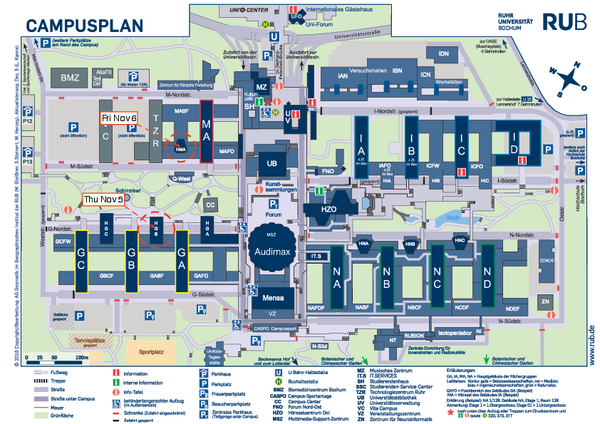
Thu Nov 5, in room HGB 30:
13:00 Reception
13:15-14:05 Luca Pol - tba
14:15-15:05 Tomas Mejia-Gomez - tba
15:05-15:45 coffee, tea, and snacks
15:45-16:35 Stefan Schwede - Equivariant K-theory as a global localization
16:45-17:35 Shay Ben-Moshe - The Redshift Bound from Quillen-Lichtenbaum
18:30 Dinner
Fri Nov 6, in room HMA 40:
9:30- 10:20 Catherine Ray - tba
10:20-11:00 Coffee break
11:00- 11:50 Jack Davies - Equivariant forms of affineness in derived geometry
12:00- 12:50 Anish Chedalavada - tba
Abstracts
Stefan Schwede: A celebrated theorem of Snaith shows that complex K-theory can be obtained from the unreduced suspension spectrum of infinite complex projective space by inverting the Bott class. A contemporary reformulation of this result is that complex K-theory classifies orientations of the multiplicative group in higher algebra.
In want to explain a highly structured, globally-equivariant refinement of Snaith's localization result: a specific morphism of ultra-commutative global ring spectra from the unreduced suspension spectrum of the global classifying space of U(1) to the global K-theory spectrum is a localization away from the "pre-Bott classes", certain representation-graded U(n)-equivariant homotopy classes for n>0.
The localization property holds in different, but interrelated senses:
- as universal morphisms in the infty-categories of ultra-commutative ring spectra and of commutative global ring spectra;
- for every compact Lie group G, as universal examples in the infty-categories of ultra-commutative G-ring spectra and of commutative G-ring spectra;
- for every compact Lie group G, at the level of G-equivariant cohomology theories.
The construction of the pre-Bott classes exploits the global functoriality and power operations.
Shay Ben-Moshe: One of the main aspects of the redshift philosophy is that algebraic K-theory increases chromatic height by one (for suitable inputs). I will present a new proof of the upper bound part, originally due to Clausen-Mathew-Naumann-Noel. The argument proceeds by descent from the case of the Lubin-Tate spectrum, which holds by another aspect of redshift, the Quillen-Lichtenbaum property, proved by Hahn-Wilson.
Jack Davies: The derived category of quasi-coherent sheaves on a scheme (or a stack) X can be complicated for a multitude of different reasons. Perhaps it requires many generators or these generators might fail to be dualisable or compact. The simplest possible situation is when the structure sheaf itself is a compact generator of QCoh(X), in which case QCoh(X) is equivalent to the category of modules over the global sections of X in spectra. In this situation, we say that X is 0-affine. There is a surprising abundance of 0-affine stacks which are not literally affine, many born out of deep theorems in chromatic homotopy theory.
In this talk, I want to introduce a generalisation of 0-affineness called G-equivariant affineness for some compact Lie group G. A (derived/spectral) stack X is G-equivariantly affine if QCoh(X) is rigid and its generators are parametrised by modules over a G-ring spectrum. This gives rise to a lot more stacks X with well behaved QCoh(X), and also also connects the algebra of the G-ring spectrum in question with the local geometry of X. I'll talk about how this question naturally arises when studying QCoh(E) for an oriented elliptic curve E, give that and many related examples, and a sketch of the proof if time allows. This is all joint work with Sil Linskens and Leonard Tokic.
If you want to join the conference dinner, please register here until 11.10.26:
Some options if you want to stay in a hotel: Hotel Claudius, Hotel Tucholsky
Here you can find a map of the campus: